

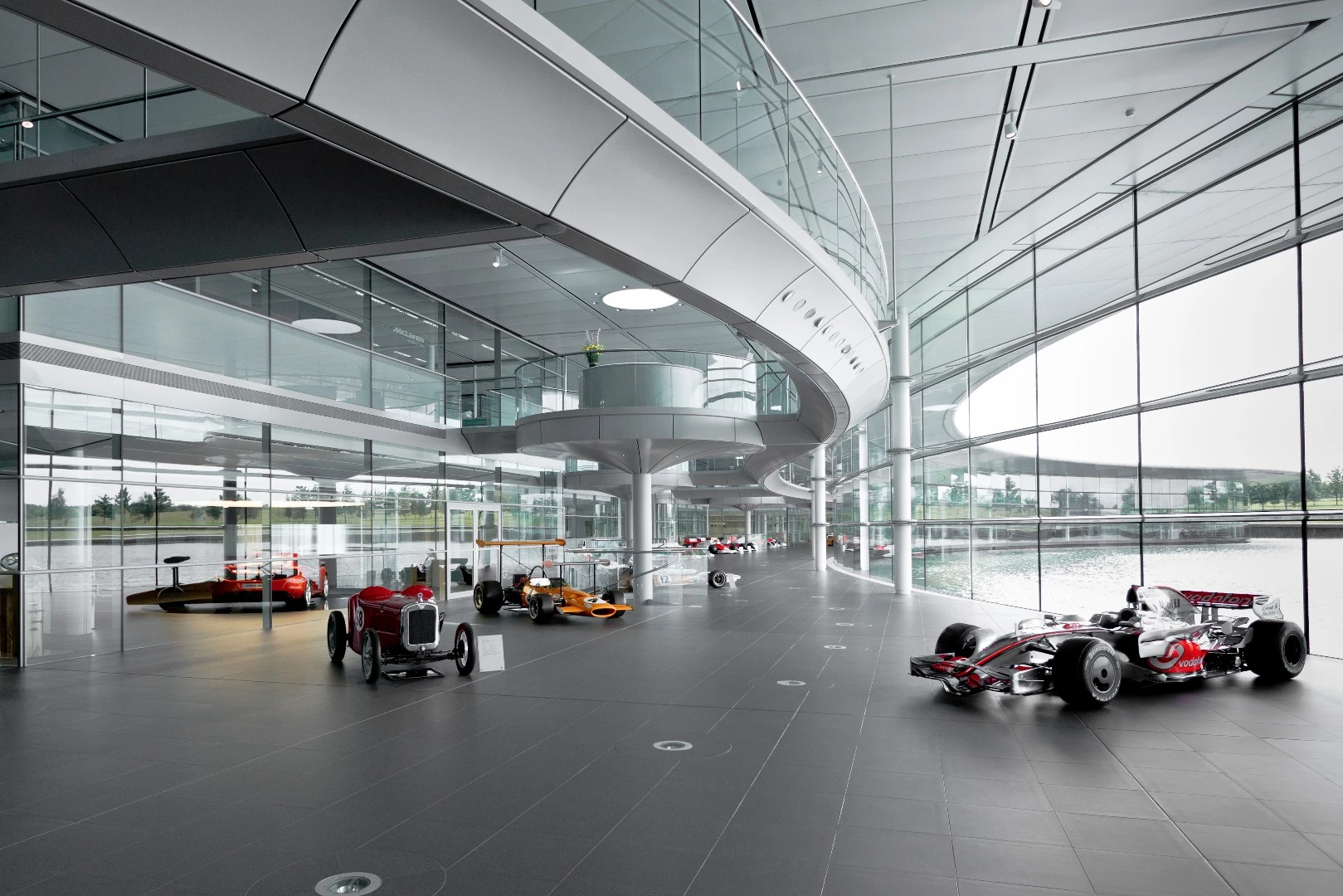
McLaren Technology Centre. The McLaren Technology Centre (MTC) stands as a beacon of technological ambition and precision engineering. Nestled in Woking, Surrey, this architectural marvel represents far more than a headquarters—it embodies a philosophy where art meets science, and vision fuses seamlessly with execution.
Every curve of the building, every glass panel, every meticulously designed workspace speaks to a culture where innovation is not incidental but essential.
In the high-octane world of Formula 1, where milliseconds dictate triumph and failure, the McLaren Technology Centre serves as both laboratory and sanctuary. It is here that cutting-edge aerodynamics, advanced materials science, and computational prowess converge to transform ideas into championship-winning machines.
From concept sketches to fully optimized F1 cars, the MTC is the crucible of modern motorsport ingenuity.
Architecture as an Ode to Innovation
Designed by the renowned architect Norman Foster, the MTC is more than a functional facility. Its sweeping curves and expansive glass facades echo the aerodynamic lines that grace McLaren cars. The building’s design facilitates natural light, encourages collaboration, and reflects the transparency that McLaren prizes in its engineering ethos.
Inside, open-plan workspaces coexist with specialized laboratories, wind tunnels, and simulators. Each zone is calibrated for precision work, reflecting the company’s mantra that engineering excellence requires an environment that nurtures creativity while demanding technical rigor.
The structure itself mirrors the philosophy of the F1 car: sleek, efficient, and unapologetically forward-thinking. It is a tangible manifestation of Exploring the McLaren Technology Centre F1 Engineering Excellence Inside.
The Heartbeat of F1 Engineering
At the core of McLaren’s operations is relentless innovation. The Technology Centre houses multidisciplinary teams—mechanical engineers, aerodynamicists, data scientists, and materials experts—working in harmony. Here, computational fluid dynamics (CFD) simulations interact seamlessly with real-world wind tunnel tests, and design concepts move from virtual renderings to physical prototypes in a matter of weeks.
The synergy of these departments exemplifies the ethos behind Exploring the McLaren Technology Centre Behind F1 Engineering Excellence. It is not merely about individual brilliance but orchestrated collaboration, where each insight compounds the next, accelerating the evolution of technology and performance.
Wind Tunnels: Sculpting Speed
No discussion of McLaren innovation would be complete without the wind tunnel—a cathedral of airflow analysis. These state-of-the-art facilities allow engineers to scrutinize every facet of a car’s aerodynamics. Minute adjustments in the front wing, diffuser, or rear spoiler can translate into measurable gains on the track.
The wind tunnel is more than just machinery; it is a bridge between theory and reality. Aerodynamicists rely on real-time data feeds and high-resolution visualization tools, iteratively refining every contour of the car. The tunnel embodies Exploring the McLaren Technology Centre A Look at F1 Innovation Excellence, demonstrating how meticulous attention to airflow can define competitive advantage.
Computational Prowess: The Digital Labyrinth
The MTC is home to a formidable digital infrastructure. Supercomputers crunch terabytes of data, simulating dynamic behaviors under countless conditions. From thermal stresses on carbon fiber composites to tire wear patterns on abrasive circuits, every variable is accounted for before a car even hits the tarmac.
Virtual prototyping has transformed the pace of innovation. Engineers iterate faster, validate concepts digitally, and reduce costly physical testing. In this domain, experimentation is limitless, and hypotheses are tested against the precision of simulated reality.
This interplay of digital mastery and physical craftsmanship is a cornerstone of Exploring the McLaren Technology Centre Discover F1 Engineering Excellence.
Materials Science: Strength Meets Agility
McLaren cars are as much about engineering as they are about materials mastery. The use of carbon fiber composites, titanium alloys, and advanced polymers is optimized to achieve a delicate balance: rigidity where it matters, flexibility where it counts.
In dedicated laboratories, materials are tested under extreme temperatures, pressures, and mechanical loads. Fatigue analysis ensures longevity without sacrificing performance. The results of these rigorous investigations manifest as cars that are not only blisteringly fast but astonishingly safe.
Here, precision meets creativity, embodying the spirit of Exploring the McLaren Technology Centre Behind F1 Engineering Excellence.
The Integration of Data Analytics
Modern Formula 1 is as much a data sport as a mechanical one. Sensors embedded throughout every component of a McLaren car provide streams of telemetry in real time. Every cornering force, brake temperature, and engine vibration is meticulously logged, interpreted, and acted upon.
Teams at the MTC analyze this wealth of information to extract marginal gains—tiny refinements that collectively determine race outcomes. Predictive analytics anticipate wear patterns and component stress, allowing engineers to preemptively adjust setups.
This marriage of analytics and engineering underscores Exploring the McLaren Technology Centre F1 Engineering Excellence Inside, revealing the depth of intelligence behind each racing decision.
Simulation Suites: Training Beyond the Track
Simulators at the MTC offer an immersive environment where drivers and engineers test scenarios that would be impossible or impractical on an actual circuit. High-fidelity simulations replicate tire behavior, aerodynamic responses, and even weather conditions.
This virtual domain accelerates driver adaptation, optimizes car setups, and supports strategic planning. Engineers can trial configurations without risking equipment or compromising schedules, compressing months of testing into mere days.
The sophistication of this approach illustrates Exploring the McLaren Technology Centre A Look at F1 Innovation Excellence, where the line between digital foresight and tangible performance is seamless.
The Collaborative Ecosystem
Beyond technology, the MTC fosters an ecosystem of innovation rooted in collaboration. Open spaces, cross-functional meetings, and communal areas are deliberately designed to encourage dialogue. Ideas flow not only between engineers but across departments—marketing, design, and management converge to ensure that every decision aligns with McLaren’s broader vision.
This culture nurtures creativity without compromising precision, a philosophy central to Exploring the McLaren Technology Centre Discover F1 Engineering Excellence. Every individual is both a specialist and a contributor to the collective intelligence of the organization.
Sustainability and Future-Focused Design
Innovation at McLaren is not confined to performance alone. The MTC integrates sustainability principles in its operations. Energy-efficient systems, optimized lighting, and advanced cooling solutions minimize environmental impact. Waste reduction and recycling initiatives complement a culture of efficiency and responsibility.
Incorporating eco-conscious engineering into a high-performance environment exemplifies forward-thinking innovation. The facility demonstrates that cutting-edge technology and environmental stewardship are not mutually exclusive.
The Human Element
Even with all the machinery, simulations, and data analytics, human expertise remains irreplaceable. Engineers at McLaren possess not only technical acumen but also intuition honed over years of racing experience. The subtle judgment that guides split-second decisions, the creativity that resolves complex engineering dilemmas, and the resilience required to push boundaries define the true essence of the MTC.
This human-machine synergy highlights Exploring the McLaren Technology Centre Behind F1 Engineering Excellence, revealing that at the heart of every car is a network of people striving for perfection.
The Evolution of McLaren Cars
McLaren’s racing legacy is built upon continuous evolution. Each generation of car reflects lessons learned, technological breakthroughs, and refined processes. From hybrid power units to aerodynamic innovations, the MTC translates research into tangible improvements on the track.
Iterative design cycles ensure that every component, no matter how small, is optimized. Engineers employ a blend of intuition, simulation, and empirical testing to produce vehicles that are both groundbreaking and race-ready.
The lineage of success demonstrates Exploring the McLaren Technology Centre F1 Engineering Excellence Inside, where history informs the future and innovation never rests.
Training the Next Generation
The MTC is also a crucible for emerging talent. Apprentices, graduates, and seasoned engineers collaborate, sharing knowledge and learning from one another. The centre functions as a living classroom, where theory meets practice and curiosity is cultivated.
By investing in human capital, McLaren ensures the continuity of its innovation culture. The next generation inherits not only advanced machinery but also the ethos of precision, collaboration, and relentless improvement.
Cross-Disciplinary Innovation
Innovation at McLaren is not siloed. Aerodynamics informs mechanical design; computational modeling influences materials choices; driver feedback refines simulation algorithms. The MTC thrives on cross-pollination, leveraging expertise across disciplines to maximize performance.
Such integration exemplifies Exploring the McLaren Technology Centre A Look at F1 Innovation Excellence, where holistic thinking converts disparate insights into cohesive, winning strategies.
Prototyping and Rapid Manufacturing
Rapid prototyping is essential to McLaren’s competitive edge. The facility houses advanced CNC machines, 3D printers, and composite fabrication tools, allowing teams to iterate quickly.
Components can be produced, tested, and refined within hours, drastically reducing development timelines. This agility is critical in a sport where innovation cycles are measured in weeks, not months.
The immediacy of creation underscores Exploring the McLaren Technology Centre Discover F1 Engineering Excellence, demonstrating how speed and accuracy coalesce in modern motorsport.
Strategic Planning and Race Preparation
The MTC functions as both a research hub and a strategic command centre. Engineers, analysts, and drivers collaborate on race strategies, evaluating circuit data, tire performance, and weather forecasts. Every variable is scrutinized, every contingency accounted for.
This meticulous preparation exemplifies the centre’s ethos. It is where theory, technology, and tactical acumen converge, reinforcing Exploring the McLaren Technology Centre Behind F1 Engineering Excellence.
Global Influence of McLaren Innovation
The technologies honed at the MTC extend beyond the racetrack. Insights from materials science, aerodynamics, and computational modeling influence automotive design more broadly. Innovations in safety, efficiency, and performance often trickle into road cars, enhancing everyday driving experiences.
This diffusion of knowledge reinforces the global significance of the McLaren Technology Centre. Its impact transcends Formula 1, shaping the future of high-performance engineering.
Conclusion: A Testament to Ingenuity
The McLaren Technology Centre embodies a rare synthesis of art, science, and ambition. Its architecture, facilities, and culture converge to create an environment where innovation thrives, precision is paramount, and excellence is relentless.
From wind tunnels to simulation suites, from advanced materials laboratories to collaborative workspaces, every element is optimized to extract the maximum potential from human ingenuity and technological prowess.
Exploring the McLaren Technology Centre A Look at F1 Innovation Excellence is a journey into this world, offering a glimpse of the cutting-edge environment where racing legends are born, and engineering history is written every day.
About the Author


