
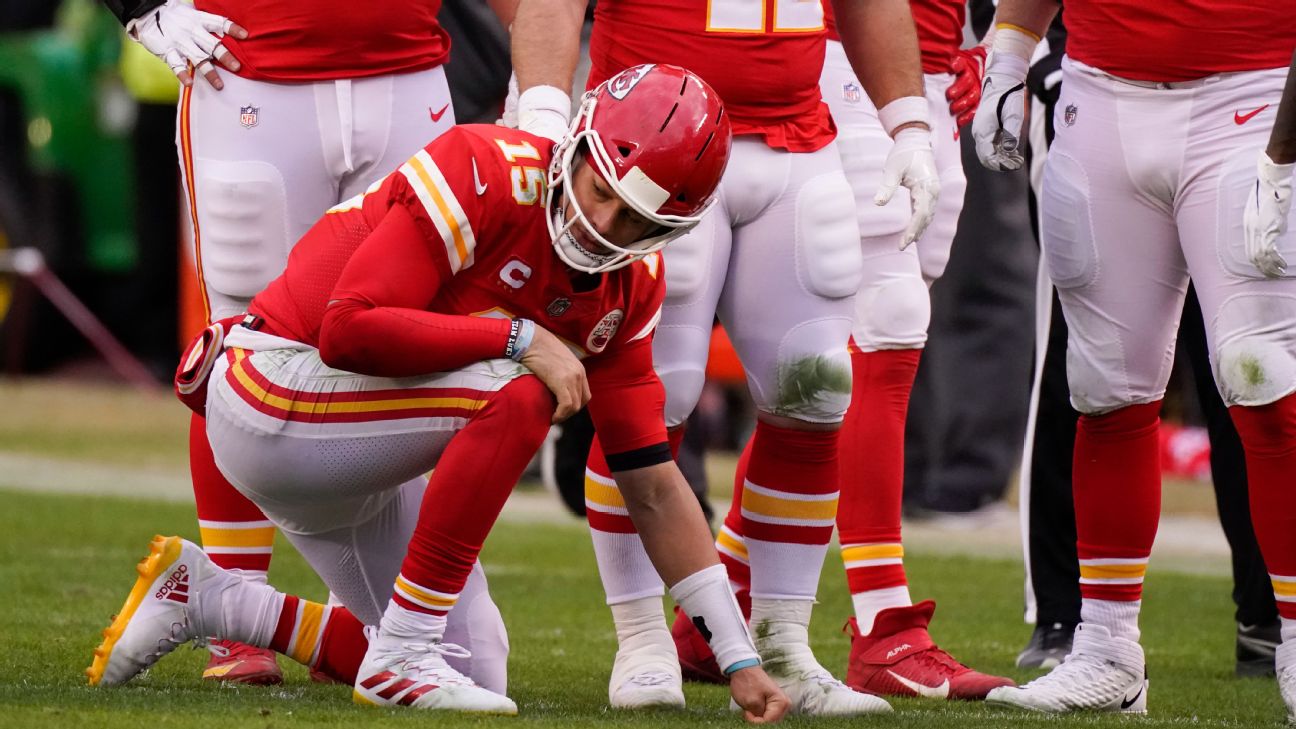
Patrick Mahomes Recovery. The news that Patrick Mahomes tore the anterior cruciate ligament (ACL) in his left knee sent shockwaves through the sports world in mid‑December 2025.
With the Kansas City Chiefs eliminated from playoff contention, what had been another remarkable season for one of the NFL’s greatest quarterbacks ended in disappointment on the scoreboard and in physical anguish. What followed was a wave of analysis, concern, strategy debates, and prognostications about the future—not just for Mahomes himself, but for the Chiefs and the broader NFL landscape.
This detailed exploration delves into the ramifications of the injury, the projected rehabilitation process, the implications for 2026, and what fans, analysts, and medical experts are saying about the road ahead.
The Injury That Changed Everything
In a pivotal Week 15 matchup against the Los Angeles Chargers, Mahomes suffered a devastating injury late in the fourth quarter. Attempting to lead a final drive, he scrambled and was tackled, causing a hyperextension of his left knee. Initial uncertainty quickly gave way to a clear diagnosis: a torn ACL—the first such major injury of his storied career.
The MRI confirmed the worst fears for Chiefs Kingdom. The injury not only ended Mahomes’s 2025 season but also eliminated Kansas City’s postseason hopes for the first time since 2014, a familiar era of dominance abruptly halted.
Moments after the news broke, Mahomes issued a message of resilience: “Don’t know why this had to happen… I will be back stronger than ever,” he wrote on social media, reflecting a tenacity that has defined his career.
This moment now frames the discussion around Looking Ahead Patrick Mahomes Recovery Timeline and What’s Next for 2026 Plans—a roadmap both grounded in medical realism and bursting with strategic expectations.
Understanding ACL Injuries in Elite Athletes
An ACL tear is one of the most significant injuries in sports, particularly for quarterbacks. The ACL stabilizes the knee during sudden pivots, cuts, and contact—movements intrinsic to football. Recovery traditionally includes surgical reconstruction followed by extensive rehabilitation.
In the NFL, ACL recoveries typically range from nine to twelve months, depending on individual response, surgical success, physical therapy quality, and absence of complications. Some athletes return sooner, while others require additional time to regain full confidence in their mobility.
For a player like Mahomes—whose game thrives on creative pocket movement, scrambling, and rapid directional shifts—the integrity of knee function is paramount. His recovery timeline will not just be about medical clearance, but about restoring the precision and mobility that underpin his playmaking ability.
This medical foundation is integral to Looking Ahead Patrick Mahomes Recovery Timeline and What’s Next for 2026 Season discussions among analysts and fans.

The Immediate Prognosis
Chiefs officials confirmed that Mahomes is considering surgical options. This is standard protocol for an ACL rupture, especially in high‑performance athletes. Surgery typically involves reconstructing the ligament using graft tissue, followed by months of strengthening and conditioning.
The immediate recovery phase focuses on reducing swelling and restoring basic motion. Immobilization gives way to controlled movement within days, and by weeks two to six, athletes often begin targeted strength exercises. Progress is measured in functional milestones rather than days on a calendar.
Yet the complexity of Mahomes’s case is compounded by the timing of the injury—coming at a juncture when the Chiefs needed every edge to salvage their postseason hopes. This juxtaposition of physical rehabilitation and strategic franchise planning feeds directly into Looking Ahead Patrick Mahomes Recovery Timeline and What’s Next for 2026 Goals narratives.
Can Mahomes Be Ready for the 2026 Season?
The oft‑cited nine‑to‑twelve‑month window places a potential return in late summer or early autumn of 2026, depending on recovery pace. That timeframe is optimistic for someone of Mahomes’s athletic caliber and access to elite medical care. But optimism does not guarantee readiness.
Physicians cautious about return‑to‑play criteria emphasize that strength symmetry, neuromuscular control, and psychological confidence must align before full reinstatement. In other words, Mahomes must not only heal structurally but also trust his knee in high‑stress, competitive environments where defenders pursue him relentlessly.
Discussions among pundits revolve around whether Mahomes could realistically start Week 1 of the 2026 NFL season. This is one of the central themes in Looking Ahead Patrick Mahomes Recovery Timeline and What’s Next for 2026 Predictions debates, where analysts weigh surgical timelines against competitive calendars.
What Rehabilitation Will Entail
Post‑surgery, Mahomes will enter an exhaustive rehabilitation regimen:
- Phase 1 (0–2 Weeks): Pain management and early mobilization
- Phase 2 (2–6 Weeks): Progressive weight‑bearing and neuromuscular activation
- Phase 3 (6–12 Weeks): Strength training and balance drills
- Phase 4 (3–6 Months): Functional athletic conditioning
- Phase 5 (6–9+ Months): Sport‑specific drills and return‑to‑play criteria
Each phase demands patience and precision. Overzealous progression can jeopardize long‑term outcomes, while overly cautious pacing delays readiness.
For Mahomes, whose livelihood and legacy are tied to physical mastery, this systematic progression is essential—not just to return, but to return as the MVP‑caliber quarterback Chiefs fans have grown accustomed to seeing.
The Strategic Implications for the Chiefs
Mahomes’s absence reshapes Kansas City’s short‑term and long‑term outlook. In 2025 the team turned to backup Gardner Minshew, who struggled under center, illustrating how pivotal Mahomes’s presence is.
Looking beyond 2025, the Chiefs face a crossroads:
- Quarterback Contingency Planning: Will they draft a future successor or bring in a veteran capable of starting in 2026?
- Supporting Cast Adjustments: Personnel decisions at wide receiver, offensive line, and tight end become pivotal if Mahomes’s mobility is compromised or delayed.
- Playbook Adaptation: Offensive schemes may shift to protect and accentuate Mahomes’s strengths as he returns.
This intersection of health and strategy is one of the most discussed facets of Looking Ahead Patrick Mahomes Recovery Timeline and What’s Next for 2026 Plans in sports commentary.
Psychological and Emotional Dimensions
Physical rehabilitation is only part of the equation. The psychological impact of a season ended prematurely, coupled with the pressure to return at full capacity, can challenge even the most resilient athletes.
Mahomes’s public message of faith, fortitude, and gratitude illustrates his proactive mindset. Instead of wallowing in “why this had to happen,” he frames the journey as a battle to “attack every single day,” an ethos that resonates with supporters and psychologists alike.
This mental resilience will be a crucial asset as he navigates rehab highs and lows—especially as speculative narratives about his readiness swirl in the media.
What Experts Are Saying
Medical and athletic performance experts have weighed in on the likely scenarios. An ACL recovery for a quarterback of Mahomes’s stature is not unprecedented, but it is not routine either. Some comparisons have been drawn to past NFL players who returned after ACL reconstruction and resumed high levels of performance—but each case is unique.
Some experts suggest a cautious, midseason 2026 return could be more realistic than a Week 1 comeback. Others frame the timeline in terms of functional milestones rather than dates, emphasizing that by the autumn of 2026 Mahomes could be cleared for contact yet still building competitive conditioning.
These expert analyses feed directly into Looking Ahead Patrick Mahomes Recovery Timeline and What’s Next for 2026 Season discussions, where fans, coaches, and analysts parse every detail for clues about availability.
Fan and Media Reaction
The broader NFL community has responded with a mixture of empathy, strategic debate, and speculation. Many fans express unwavering loyalty, celebrating Mahomes’s determination and acknowledging the uncertain road ahead.
Media outlets have published varying outlooks, some bullish on a late‑summer 2026 return and others more reserved, emphasizing the risk of rushing recovery and potential for re‑injury.
This blend of hope, caution, and deep engagement underscores how central Mahomes is to the Chiefs franchise and the sport itself.
The 2026 Season in Context
Even if Mahomes starts the 2026 season, the Chiefs may not resemble the team that dominated the early 2020s. The NFL landscape is dynamic, and roster changes, salary cap pressures, and emerging competitors will test Kansas City’s mettle.
Strategists speculate about:
- Draft picks to bolster offensive and defensive depth
- Free‑agency moves to protect Mahomes and improve scoring options
- Coaching adjustments to leverage a potentially evolving Mahomes skill set
In this strategic matrix, Mahomes’s health is the linchpin. His presence—or prolonged absence—alters the calculus of every decision.
Potential Scenarios for 2026
Scenario 1: Early 2026 Return
In this optimistic view, Mahomes returns by late summer or early autumn. He regains rhythm gradually and leads the Chiefs into playoff contention. This represents the most optimistic interpretation of Looking Ahead Patrick Mahomes Recovery Timeline and What’s Next for 2026 Predictions.
Scenario 2: Midseason Debut
Here, Mahomes starts the season in rehab phases and rejoins midseason, bringing explosive talent and leadership at a critical stretch. The early season becomes developmental for his backup.
Scenario 3: Delayed Return
In this conservative scenario, Mahomes’s medical team prioritizes long‑term health, delaying full competition until deep into 2026 or even into 2027 training camp. This ensures durability but necessitates aggressive contingency planning.
Each scenario carries strategic ripple effects on roster building, offensive dynamics, and fan expectations.
Legacy and Long‑Term Outlook
Mahomes’s legacy is already enshrined in NFL history—with multiple MVP awards, Super Bowl victories, and a generational impact on how the quarterback position is played. An ACL injury, while significant, is unlikely to diminish that legacy if he completes a thoughtful and disciplined recovery.
Legacy discussions now intertwine with projections about his post‑injury career arc. Will this mark a resurgence? A reinvention? Or a meticulous reintegration into a sport that demands physical excellence and unparalleled competitive drive?
The answers will emerge over months of rehabilitation, training camp evaluations, and early‑season performances.
Conclusion
The narrative arc of Patrick Mahomes’s injury and recovery has become one of the most compelling storylines in modern professional sports. As the world digests the reality of his torn ACL and what it means for Kansas City’s immediate and long‑term fortunes, the discussions span medical science, strategic football planning, leadership psychology, and sheer human resilience.
Through all of this, Looking Ahead Patrick Mahomes Recovery Timeline and What’s Next for 2026 Plans remains an evolving conversation—a confluence of optimism, caution, and analytical depth.
Whether he returns in time for opening kickoff or gradually regains form throughout the 2026 campaign, Mahomes’s journey back from injury will be watched with intense interest by fans, peers, and future generations of athletes alike.
The path ahead is challenging. Yet in the paradoxical landscape of professional sports, adversity often yields reinvention—and Mahomes’s comeback narrative promises to be one of the most scrutinized, inspiring, and defining chapters of his career.
About the Author




