
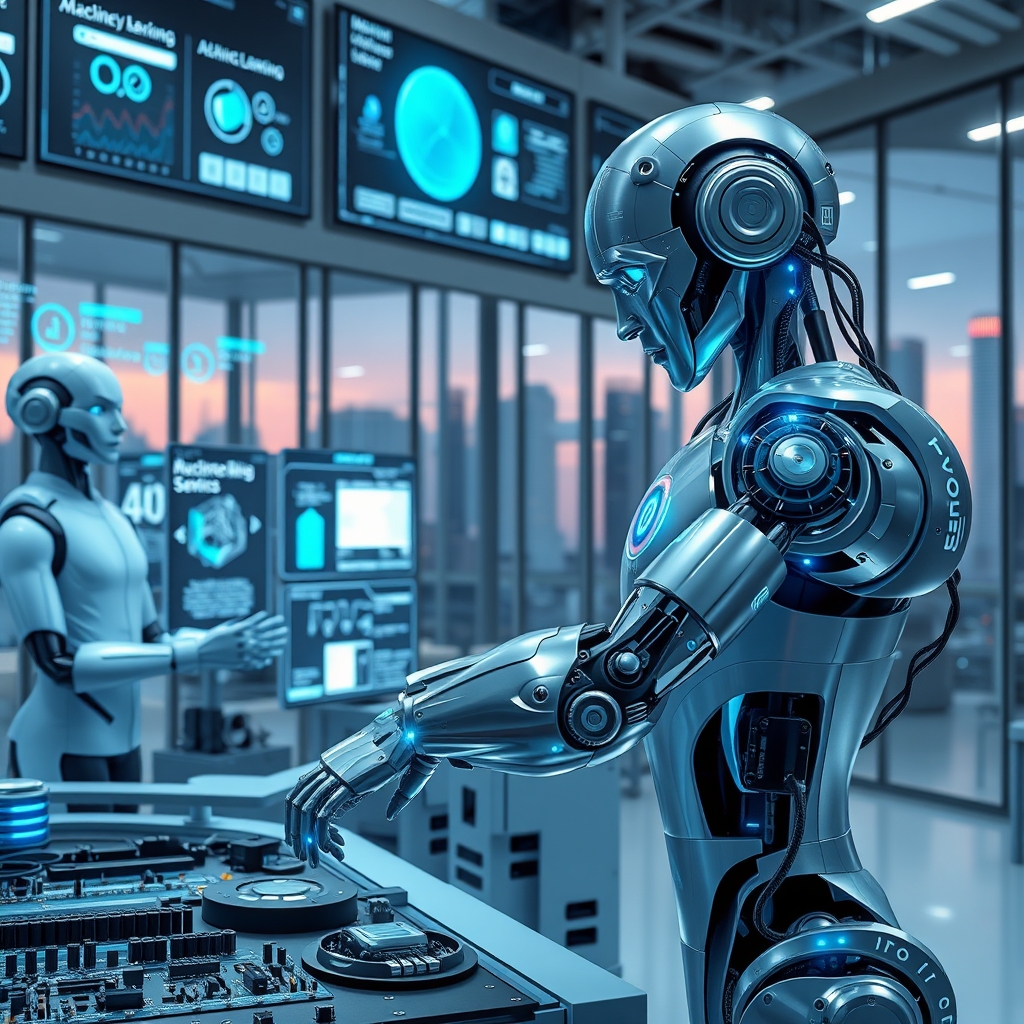
Artificial Intelligence (AI) and Machine Learning (ML) are revolutionizing Robotics & Automation, creating smarter, more efficient systems that redefine industries. By integrating AI-driven algorithms with robotic hardware, businesses achieve unprecedented precision, adaptability, and cost savings. This synergy is not just a trend—it’s a fundamental shift in how technology interacts with the physical world. From manufacturing floors to healthcare labs, AI and robotics are merging to solve complex challenges faster than ever before.
Recent data shows that global spending on AI in robotics reached $15.4 billion in 2023, with projections exceeding $35 billion by 2025. This surge reflects growing confidence in AI’s ability to enhance automation, reduce human error, and optimize workflows. Furthermore, industries adopting these technologies report up to a 40% increase in productivity, proving their transformative potential. As AI models become more sophisticated, their integration with robotics is unlocking new possibilities, from autonomous vehicles to personalized manufacturing.
How Are AI & Machine Learning Enhancing Robotics & Automation?
AI and Machine Learning empower robots to learn, adapt, and make decisions in real time. Unlike traditional programmed robots, AI-driven systems analyze vast datasets to improve performance continuously. For example, collaborative robots (cobots) in factories use ML to predict maintenance needs, reducing downtime by 30%. This self-optimizing capability is a game-changer for industries reliant on precision and efficiency.
In addition, AI enhances robotic vision, enabling machines to recognize objects, navigate environments, and perform tasks with human-like dexterity. Warehouse robots, for instance, use computer vision to sort packages at speeds impossible for human workers. These advancements are not limited to industrial settings—AI-powered surgical robots assist doctors with millimeter-level accuracy, improving patient outcomes. The fusion of AI and robotics is blurring the lines between automation and intelligence, creating systems that evolve alongside human needs.
What Industries Benefit Most from AI-Driven Robotics?
Manufacturing remains the frontrunner in adopting AI and robotics, with 65% of factories implementing automation solutions by 2024. However, healthcare, logistics, and agriculture are rapidly catching up. In logistics, AI-driven drones and autonomous forklifts streamline supply chains, cutting delivery times by 25%. Meanwhile, agricultural robots equipped with ML analyze soil conditions and optimize crop yields, addressing food security challenges.
Healthcare is another sector experiencing a robotic revolution. AI-powered diagnostic tools assist radiologists in detecting diseases with 95% accuracy, while robotic prosthetics restore mobility for amputees. These innovations demonstrate how AI and robotics are not just improving efficiency but also enhancing quality of life. As technology advances, even small businesses are leveraging automation to compete with industry giants, democratizing access to cutting-edge solutions.
What Challenges Does AI & Machine Learning Face in Robotics?
Despite its promise, integrating AI with robotics presents hurdles. One major challenge is the high cost of development, with AI-powered robotic systems often exceeding $100,000 per unit. Small and medium enterprises (SMEs) struggle to justify these expenses, slowing widespread adoption. Additionally, ethical concerns surrounding job displacement persist, as automation threatens to replace 85 million jobs globally by 2025.
Another obstacle is the complexity of AI training. Robots require massive datasets to learn effectively, and biases in data can lead to flawed decision-making. For example, facial recognition robots have shown higher error rates for people of color, highlighting the need for diverse training sets. Furthermore, regulatory frameworks lag behind technological advancements, creating uncertainty for businesses investing in AI-driven robotics. Addressing these challenges is crucial for ensuring sustainable and equitable growth in the field.
Will AI & Machine Learning Replace Human Workers in Robotics?
While AI and robotics automate repetitive tasks, they also create new opportunities for human workers. Studies show that for every job lost to automation, 1.7 new roles emerge in tech-driven fields. For instance, AI-powered robots in manufacturing require human oversight for programming, maintenance, and quality control. This shift demands reskilling, with 54% of employees needing significant training to adapt by 2025.
Moreover, AI excels at data analysis but lacks human creativity and emotional intelligence. Jobs requiring empathy, such as nursing or customer service, remain irreplaceable. Instead of replacing humans, AI and robotics augment their capabilities, allowing workers to focus on higher-value tasks. The future of work lies in collaboration between humans and machines, where each complements the other’s strengths.
What’s Next for AI & Machine Learning in Robotics & Automation?
The next frontier for AI and robotics is edge computing, where AI processes data locally on robots rather than relying on cloud servers. This reduces latency, enabling real-time decision-making for autonomous vehicles and drones. By 2026, 75% of enterprise-generated data will be processed at the edge, accelerating innovation in robotics.
Another exciting development is the rise of swarm robotics, where groups of AI-powered robots collaborate to complete tasks. Inspired by nature, these systems mimic the behavior of ants or bees, offering scalable solutions for search-and-rescue missions or large-scale construction. As AI models become more energy-efficient, robots will operate longer on smaller batteries, expanding their applications in remote or hazardous environments.
In conclusion, AI & Machine Learning are reshaping Robotics & Automation, driving efficiency, innovation, and new economic opportunities. While challenges like cost and ethics persist, the benefits far outweigh the risks. As industries embrace these technologies, the future of work will be defined by human-machine collaboration, unlocking possibilities we’ve only begun to imagine. The journey has just started, and the next decade promises even greater breakthroughs in AI-driven robotics.
FAQ: Common Questions About AI & Machine Learning in Robotics & Automation
How Does Machine Learning Improve Robotic Precision?
Machine Learning enhances robotic precision by analyzing performance data and adjusting movements in real time. For example, robotic arms in electronics manufacturing use ML to place components with 0.01mm accuracy, reducing defects by 50%. This continuous learning loop ensures robots adapt to new tasks without reprogramming.
What Are the Costs of Implementing AI in Robotics?
Implementing AI in robotics varies widely, with basic systems starting at $20,000 and advanced solutions exceeding $500,000. However, the return on investment is substantial—companies report a 30% reduction in operational costs within two years. Cloud-based AI services are also lowering barriers, offering pay-as-you-go models for smaller businesses.
Can AI-Powered Robots Operate Without Human Supervision?
While AI-powered robots can perform tasks autonomously, most still require human oversight for complex decision-making. For instance, autonomous delivery robots navigate sidewalks independently but rely on remote operators for unexpected obstacles. Full autonomy remains a goal, with researchers aiming for 90% self-sufficiency in controlled environments by 2027.
About the Author


